

8. Ceramic Development in China
| 757 Page: 94 of 418 Go To Page: |  |
◁◁ First | ◁ Previous | Next ▷ | Last ▷▷ |
The Han period of some 400 years of more or less continuity and prosperity brought about a cultural flowering as the relationship between politics, art and intellect became closer. The Han’s first capital was in Luoyang, to the East, but around 200 BC they began construction of a new capital, Chang-an, described as the “first great city in Chinese history”. It grew to a population of a quarter of a million people. This was located to the West, about half way between the capital of the Qin, Zianyang, and present day Xian. Confusingly the name Chang-an was not used uniquely for a single location, but was reused by subsequent Dynasties for their capitals in or near Xian.
There was one period of unrest that led to civil war for some 30 years. As an example of history more or less repeating itself, this was caused by another Regent (Wang Mang) for an underage Emperor, who attempted to set up his own Xin Dynasty. During the fighting the Capital, Chang’an, was destroyed (Denoting the end of the Western Han Period - 206 BC to 9 AD). Over the next 300 years Chang’an fell to the status of an ordinary Provincial city. When peace ensued the Han Empire flourished again and the new Capital again became Luoyang, in the east of the Han State (Eastern Han Period 25 to 220 AD).
The Han Dynasty led to innovations to improve agriculture by irrigation, including dams, and canals for food transport. Paper was invented in about 100 AD from vegetable pulp (mostly bamboo) left to dry on screens of split bamboo. It was much cheaper than parchment (animal skin). Together with the development of inks, this encouraged the use of writing. Chinese characters, which were invented before 1,000 BC, started to be standardised in the Han Dynasty, and were also adopted by the inhabitants of Korea and Japan. Improvements were made in industry, for example in iron casting, and factories were set up for lacquer work and silk production.
There were some large terracotta figures of remarkable liveliness produced in the Han and on through the Tang Dynasties, particularly alongside the “Ways of Souls” leading to tombs, which relied on the technology developed by the Qin. In the Han Era, small pottery figure models, often of servants, again replaced human sacrifices, which still occurred previously on the death of a very prestigious person. Han tombs are among the most elaborate in China. They were made of fired clay bricks, with a vaulted roof and covered in gigantic mounds of earth. Later they were made by digging into natural hills (ready made mounds). They were lined with fired bricks, rectangular and triangular, with a combination of stampings to create pleasing rural scenes. Some stamped bricks in Chengdu were a relatively large at 16” x 19”. After firing, figures, birds and other animals in relief were picked out with colours. Some had geometric patterns alternating with bands of lively processions of dragons, men in chariots and figures from mythology. They were the reflections of splendid carved and painted scenes found in the tombs of the very rich.
A particularly fascinating tomb of a noble woman, Marchioness Dai, dated 168 BC, was richly equipped and well preserved. There was a Kaolin clay outer layer to prevent moisture ingress and an inner layer of charcoal that removed all oxygen within a day of burial. This prevented decay, which was considered very important at this time. From contemporary literature so much was spent on tombs and their contents that powerful men were reduced to penury after ensuring that their parents were interred in the proper way.
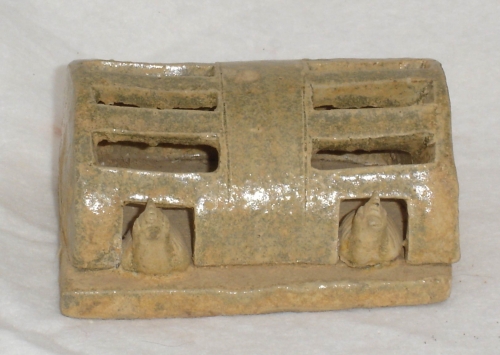
Han celadon glaze stoneware toy - courtesy
Glade Antiques
Hard-glazed ware became firmly established with increased control of firing and careful selection of clays for throwing large pieces on a wheel.In Henan Province they still produced high-fired stoneware with thin brownish to olive green glaze. However, the main production centre was shifting to the kilns of Eastern Han in North Zhejiang Province – in the old kingdom of Yueh. There they produced high-quality, hard, grey stoneware, often imitating bronze vessels, with impressed designs under a thin olive green glaze. Other important Han pottery production was in Changsha (Hunan Province) that became an important South Central area for various wares, and Chengdu and Chongqing (Sichuan Province).
| Page: 94 of 418 Go To Page: | |
◁◁ First | ◁ Previous | Next ▷ | Last ▷▷ |
Author: Dr. Stan Jones © Copyright 2010 -