

8. Ceramic Development in China
| 758 Page: 95 of 418 Go To Page: |  |
◁◁ First | ◁ Previous | Next ▷ | Last ▷▷ |
Chinese potters of this time were experimenting with lead silicate glazes coloured with copper oxide (green after oxidation by firing) and iron oxide (amber yellow). This particular glazing technique possibly reached China from the Near East along the Silk Road, as lead fluxed glazes had been used there in small quantities well before 1000 BC, or it may have been an indigenous development. Lead compounds were well known to the Chinese as they added lead to their bronze to improve casting. Glazes with lead as the principal flux, usually with copper, were often used in the Roman period that was contemporary with the Han. They were technically not easy glazes to handle, as they were unstable and difficult to apply. The firing temperature has to be low as lead becomes volatile at 1150 degrees C. Lead glazes also run during firing and can crack when cooling due to poor thermal match with some bodies. Lead in the form of red or yellow oxide, white lead and galena can be powdered on to the damp clay body or the lead compound can be held in suspension in water and applied by brushing or dipping. Lead glazes have the advantage of being bright and smooth, and taking coloured metal oxides well. They are particularly good for earthenware bodies, especially those rich in iron, as the colourant conceals the body colour. Lead glaze is also a reasonably good thermal fit for earthenware and is useful in making it impermeable. In North China they used a low-fired lead glaze that was tinted bottle green with copper oxide and took on a silvery iridescence after burial for some time. Lead glazes were confined to cemetery pottery, which was a good thing as the lead used in glazes is notoriously poisonous. The mortality rate amongst potters was high in Chang-an and Lo-yang that were the most important centres in West and East Han, respectively.
During the Han period there was a very rich variety of unglazed, fired and unfired (or “cold”) painted and lead-glazed ceramic grave goods.
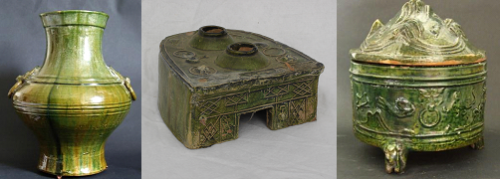
Han burial pieces (Mingqi) green glazed
vase, kitchen stove and cosmetic jar -
courtesy R&G McPherson Antiques, Glade
Antiques and R&G McPherson Antiques
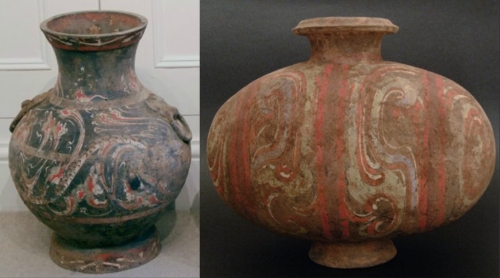
Western Han cold painted vessels 206 BC-8
AD - courtesy R&G McPherson Antiques
Just about every bronze and lacquer vessel was copied. They included pottery models of people (dancers, acrobats, musicians and gamblers), animals and possessions dear to the departed in life.
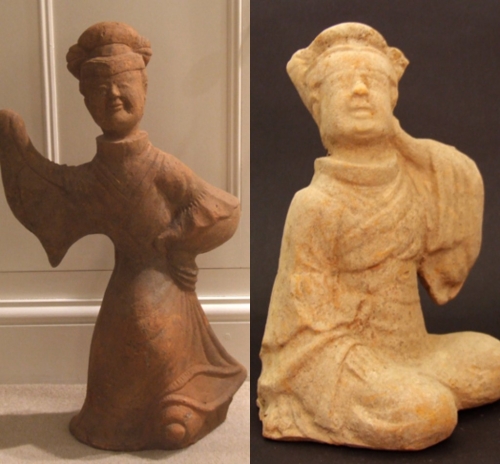
Eastern Han Mingqi figures of dancer
and entertainer - courtesy R&G
McPherson Antiques
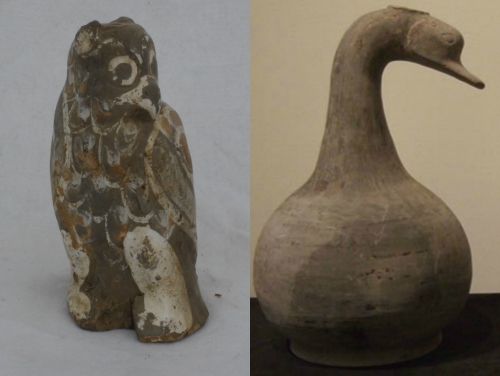
Han owl rat scarer and goose headed vessel
- courtesy Glade Antiques and R&G
McPherson Antiques
There were also detailed small ceramic models of contemporary buildings (houses, farms, watchtowers, pigsties) about the same size as dolls houses today, which show the variety and vigour of the social scene as well as advances in architectural design, as most full-sized buildings of this date have disappeared.
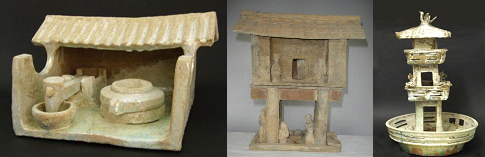
Han building models, milling shed, house on
columns and watch tower - courtesy
R&G McPherson Antiques
Ceramic bowls were placed in graves to contain food and drink. Jade was also thought to prevent decay, so members of noble families might be buried with an entire suit made of small plates of jade to preserve the body for survival in another dimension. By the first century BC pottery models of gardens were also introduced. Gardens had a very different role in China, as they were devised to entice the Immortals into the garden, as well as showing off the power of the owner – so the Emperor’s garden was very impressive. Ceramic bowls were placed in the garden to collect dew that was the Immortals favourite drink. These models and other items give a very good insight into the customs of the people at the time.
| Page: 95 of 418 Go To Page: | |
◁◁ First | ◁ Previous | Next ▷ | Last ▷▷ |
Author: Dr. Stan Jones © Copyright 2010 -