

8. Ceramic Development in China
| 787 Page: 127 of 418 Go To Page: |  |
◁◁ First | ◁ Previous | Next ▷ | Last ▷▷ |
Vast quantities of elegant porcelain were made by the most varied production techniques and decorative subjects, with decoration and shapes designed to meet the various customers’ tastes and quality requirements. Pottery production in the South expanded greatly once the kilns had been repaired chiefly centred on Jingdezhen. Exports plus Imperial and domestic demand caused great technical and decorative excellence. The somewhat coarse-bodied Shu-fu ware was further developed into a hard white porcelain, mechanised to the extent that it no longer revealed the touch of the potter. The practically invisible designs often carved into the translucent body were known as an-hua or “secret decoration”.
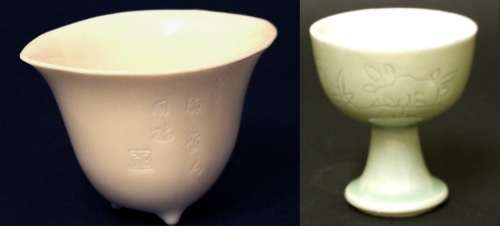
Ming an-hua incised decoration - courtesy
R&G McPherson Antiques
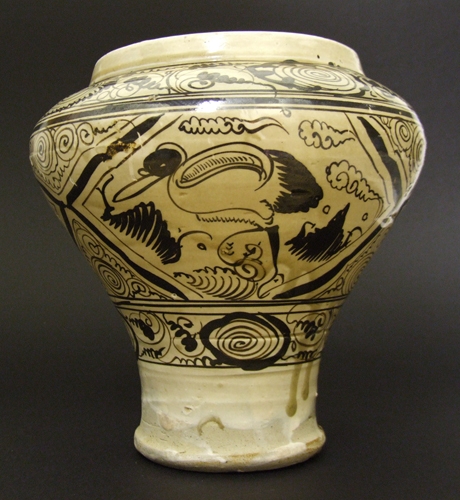
Ming Cizhou stoneware, brown iron oxide on
cream slip depicting a crane - courtesy
R&G McPherson Antiques
The Northern traditions of Tz’u chou and Chun ware continued to decline.
Initially Longquan stoneware celadon was of good quality, but became heavy and coarse after the first quarter of the 15th century, with a marked decline in quality – often with an uneven yellowish-brown colour.
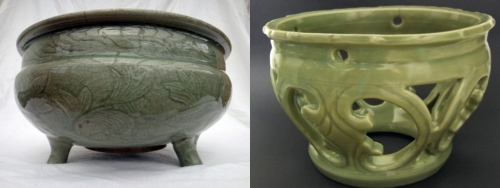
Early Ming celadon censor and separate
stand - courtesy Glade Antiques and
R&G McPherson Antiques
The kilns at Jao-chou succeeded as they maintained high levels of craftsmanship, were well organised and had very consistent production (due largely to mechanisation) and sound financial backing.
One reason Court interest was raised in Jao-chou products in the first quarter of the 15th century was that the potters came up with new decorative styles. Officials of the Board of Public Works personally carried Imperial orders to the ceramics factories, with specially prepared drawings for the potters to follow. By the end of the first quarter of the century despatches were made of plain white, blue, and red monochrome porcelain bowls and stem cups for use on the ancestral altars of Princes. In 1433 the first recorded orders for blue and white porcelain were received, and in that year an order for 433,500 pieces of porcelain was received that were to be decorated with dragons and phoenixes, indicating the size the industry had become.
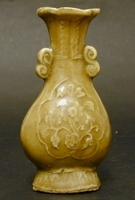
Later Ming celadon
- courtesy R&G
McPherson Antiques
In the Yongle period (1402-24) the practice began of putting the Emperor’s reign mark on the base of ceramic wares. This was first applied to the finest white porcelain and to monochrome ware decorated with (now perfected) copper red under a transparent glaze. In the early Ming decades, Yuan (Mongol) blue and white ware continued to be produced and refined. At first it was considered vulgar so no reign mark was applied until the Xuande period (1425-35). Unfortunately Reign Marks were perpetuated in other periods, not necessarily to deceive, but more in admiration. So Xuande and Chenghua marks were used in the second half of the 16th century, and some 18th century copies of 15th century pieces are particularly difficult to differentiate.
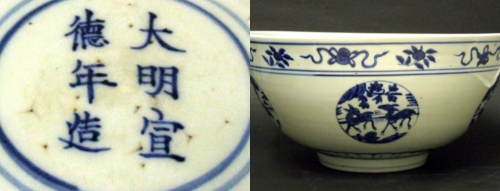
Ming Xuande bowl and mark - courtesy
R&G McPherson Antiques
By the Xuande period, the often-crowded Yuan patterns had given way to dragons and floral motifs of great clarity and grace, vigorously applied in a thick, deep-blue pigment to dishes, vases, stem cups and flattened pilgrim flasks. Some also had dragons in underglaze red on a blue ground and vice versa. A new motif used the “three friends” – prunus, bamboo and pine, symbolising beauty, integrity and long life, often used in a naturalistic scene.
| Page: 127 of 418 Go To Page: | |
◁◁ First | ◁ Previous | Next ▷ | Last ▷▷ |
Author: Dr. Stan Jones © Copyright 2010 -