

8. Ceramic Development in China
| 788 Page: 128 of 418 Go To Page: |  |
◁◁ First | ◁ Previous | Next ▷ | Last ▷▷ |
The period between the death of Xuande in 1435 and the start of Chenghua’s reign in1464 is known in ceramics history as the Interregnum, when production from the Jao-chou kilns fell significantly. However, production and quality improved markedly between 1465 and 1487. The body was thinner, lighter and more translucent, the glaze was thick and glassy and the underglaze colour an even soft greyish-blue. In the Chenghua period (1464-87) the blue and white designs were more tenuous and refined.
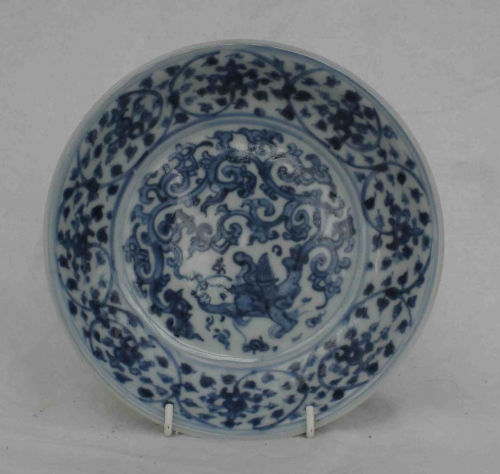
Ming Chenghua blue and white dish -
courtesy Glade Antiques
Overglaze enamelling finally appeared in Jingdezhen in the middle of the 15th century. The earliest examples were only green and red, but by the end of the century there were a number of variants. Two popular ones were Tou-tsai “dove tailed colours” and Wu-tsai “five colours”. The former used blue underglaze to define the outline of the design and some detail, and then the overglaze enamel filled in the outline. The Court especially admired this ware, as it was very appealing and high quality. Wu-tsai only used overglaze enamels, so mistakes could easily be wiped off the fired glaze. Colours used were green, yellow, turquoise, aubergine purple, red and later black. The red and black were mainly used to outline the design. More ambitious designs were used such as figure scenes
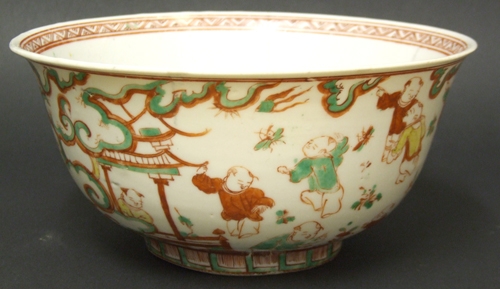
Ming overglaze enamels, boys near pavilion
- courtesy R&G McPherson Antiques
Overglaze painting was applied with delicate care in the Cheng-hua period, particularly the favourite wine cups with chicken motifs. Another variant arose towards the end of the 15th century that was to enamel the fired unglazed body (biscuit), which resulted in a very different effect. It produced very striking brilliant colours with great visual impact.
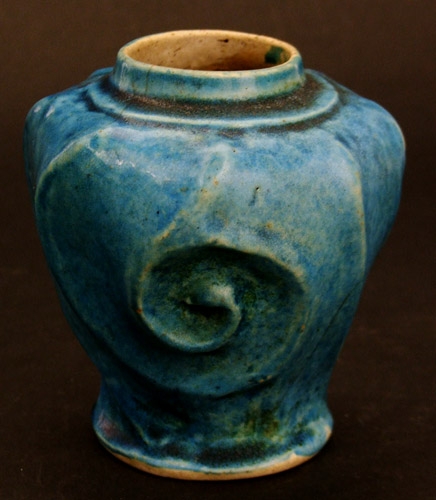
Late Ming moulded porcelain vase, biscuit
glazed - courtesy R&G McPherson
Antiques
Two styles evolved, San-tsai “three colours” in which yellow is the predominantly background with the incised decoration coloured green, and the other Fa-hua is cloisonné-like. The decoration is outlined in thin threads of slip, details were then inscribed and enamels were painted onto the fired body in the same way that enamel pastes are put into the cells or cloisons of metal-based cloisonné. The colours are more varied than in San-tsai and the backgrounds are usually cobalt blue or copper turquoise.
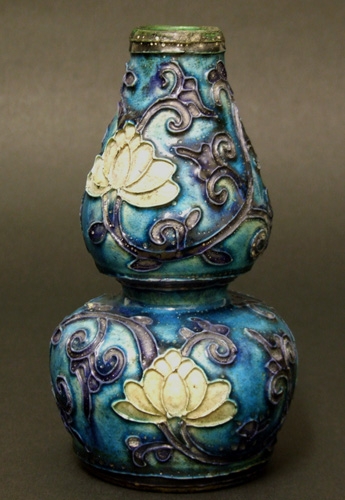
Ming double gourd vase - courtesy R&G
McPherson Antiques
The shapes of these most impressive wares are chiefly vases and jars decorated with floral motifs in turquoise, purple, yellow and deep violet blue, although some items were large such as Kuan jars, Meiping vases and even garden seats in the form of drums. The best of these were produced from 1450 to 1550. In a few cases the potters formed a double-shelled piece, piercing the outer so the glazed inner shell, which was added later, was visible through the openwork. Technical standards in the Chenghua and Hongzhi (1487-1505) periods were not surpassed until the early 18th century in the Qing Dynasty.
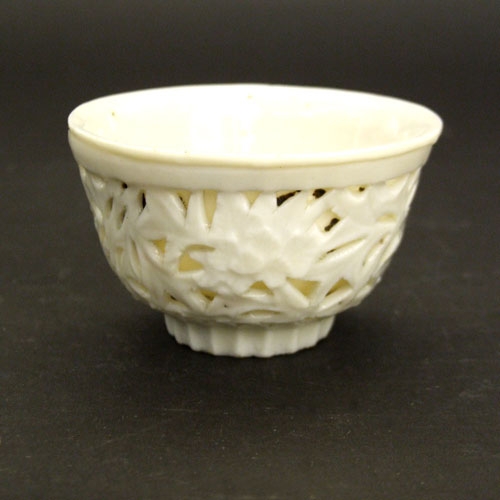
Late Ming, Transitional Period,
reticulated cup - courtesy R&G
McPherson Antiques
In contrast, carelessly produced thick porcelain items were produced for export to South East Asia from Shantou. Shantou was a South Chinese shipping port and its porcelain came from private kilns that, at that time, did not measure up to the Imperial factories in Jingdezhen, where the materials and finished goods were quality controlled.
| Page: 128 of 418 Go To Page: | |
◁◁ First | ◁ Previous | Next ▷ | Last ▷▷ |
Author: Dr. Stan Jones © Copyright 2010 -