

10. European Pottery to the Fall of the Romans
| 1032 Page: 270 of 418 Go To Page: |  |
◁◁ First | ◁ Previous | Next ▷ | Last ▷▷ |
Seleucia rose in size and importance to vie with Alexandria, and in the reign of Antiochus III “The Great” became larger than Antioch. Antiochus crossed the Hellespont to conquer Thrace, but entering Europe was his downfall, as the Romans were not prepared to accept the intrusion. War between these two superpowers broke out in 192 BC. The Macedonian phalanx proved ineffective against the tactics of the Roman legions. Although Antiochus received help from many Greek towns and the Carthaginian general Hannibal, the Romans prevailed and the Seleucians had to pay a huge sum of money in reparation and, as described below, lost its control of its possessions in Anatolia.
Alexandria in Egypt had taken over as the centre of learning from Athens, and there was a steady emigration of Greeks from the Heartlands to the New Greek Empires. New cities were set up round the Mediterranean, the Black Sea and into Asia, however this caused Greece itself to be depopulated and the previous democratic society declined. A revised version of the Greek language called “Koine” or “common” spread throughout the Empires, replacing several previous ones and it became the most pervasive language in the Middle East, displacing Aramaic. It was the language used for the New Testament and throughout the Byzantine Empire until 1,453 AD. It is of interest that some 12% of English words have a Greek origin.
Because of the increased warfare between these new Greek Kingdoms a great deal of development effort went into warfare, such as siege engines and the use of elephants in the battlefield, the latter, first used by Pyrrhus, was further developed by the Seleucids and Ptolemys.
During the Hellenistic period the decoration on mainland Greek pottery declined and was predominantly festoons of ivy and vine in white or yellow on a black ground, which no longer had the previous lustre. Vases with relief or impressed decoration especially ribbing appeared. One such is the “Megarian” hemispherical bowl that was made in imitation of metal ones, moulded on a wheel with very striking deep relief decoration, and coloured red/brown to black.
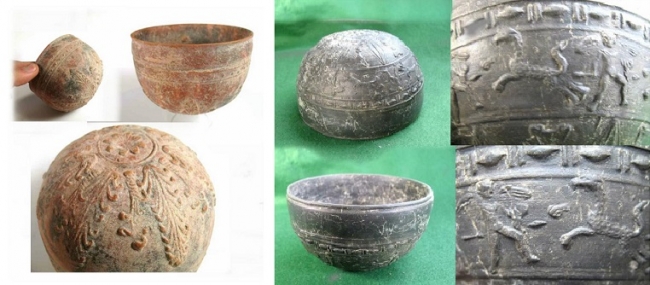
Hellenistic Megarian bowls, late 3rd
century BC source Collector-Antiquities,
and 3rd-2nd centuries BC
The clay shrank when drying, making removal from the mould easier. Some reliefs based on animals and mythological creatures were quite complex. The 5th century BC tradition of polychrome figural decoration continued, with some additional colours applied after firing, as these colours could not withstand firing temperatures. Again these vessels were mainly used for funerals. Notable examples came from Sicily using pink, blue, yellow and white. West Slope ware, called that as it was found on the west slope of the Acropolis, was produced from the 3rd to 1st century BC and had a dark ground with painted decoration.
In Egypt in the Hellenistic Period they used an alkali glaze on some of their fritware that was also used on earthenware as early as 300 BC. It was made of soda, ash, sand and chalk or white clay, mixed with water and brushed or poured over the vessel. Success was not guaranteed and took great care to achieve the correct temperature to get the glaze to melt. In the first century BC Corinthian potters sometimes used an alkali glaze with added lead.
Some of the most notable pottery in the Hellenistic Period came from Seleucia, and large quantities have been found. The art in Seleucia was influenced greatly by the conjunction of Cultures due to its geographic situation so that Greek, Persian and Mesopotamian technology combined in new ways to give a distinctive form of expression. They range from fine glazed to cooking ware.
| Page: 270 of 418 Go To Page: | |
◁◁ First | ◁ Previous | Next ▷ | Last ▷▷ |
Author: Dr. Stan Jones © Copyright 2010 -