

6. Spread of Agriculture, Pottery and Civilisations
| 839 Page: 45 of 418 Go To Page: |  |
◁◁ First | ◁ Previous | Next ▷ | Last ▷▷ |
The impressive dockyards, granaries (for wheat, barley and some rice), warehouses, brick platforms and protective walls demonstrate the advanced architecture of the Harappans. The proportion of fired and unfired bricks varied, with most bricks in Mohenjo-Daro being fired and looking very much like bricks today. Rectangular bricks were of different sizes but standardised shape with length twice the width and width twice the thickness (typically 11”x 5”x 2.5”) with levelled top and roughened underside.
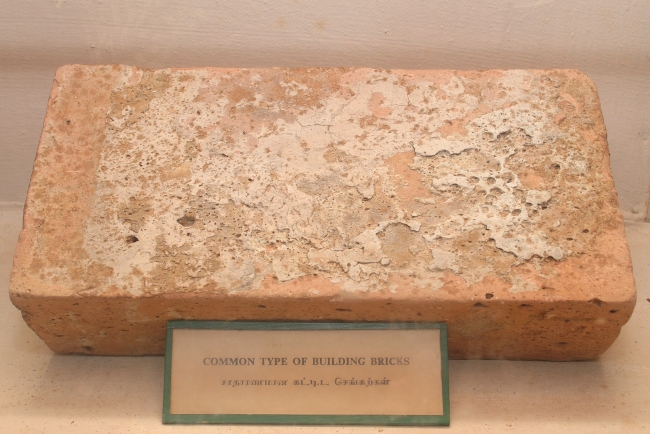
Standard Fired Brick - courtesy Government
Museum, Chennai
In some cities only wet areas such as bathrooms, wells and drains were fired. Because of the comparatively heavy rainfall sun-dried bricks were rarely used externally. Unfortunately, in 1857 the British authorities used Harappan bricks in the construction of the East Indian Railway line, connecting Karachi and Lahore.
The massive hill citadels that seem to be to protect the population from floods and attackers were larger than most similar structures in Mesopotamia. The significant difference is that there do not seem to be any obvious temples or palaces. There was, however, at least one large ceremonial bath 12 m long, 7 m wide, and 2.5 m deep, made of several thicknesses of brick and bitumen probably used for sacred ablutions. It was surrounded by a cloistered walkway 2m wide.
Excavations at Harappa revealed burials containing dismembered remains, associated with red-slipped burial vessels decorated with black paint. Very many ritual pottery objects were found, often mass-produced in moulds, and terracotta stands were used to hold offerings. Other vessel styles were plain pots with cream coloured slip, rare untempered black-slipped polished grey ware – smooth and soapy to the touch, and small vessels in red, black, green and occasionally yellow. There were many shapes including saucer-shaped bowls, tall thin vessels, chalices, goblets, dishes on stands, perforated jars, tumblers, plates, charcoal heaters and even miniature pottery as toys for children.
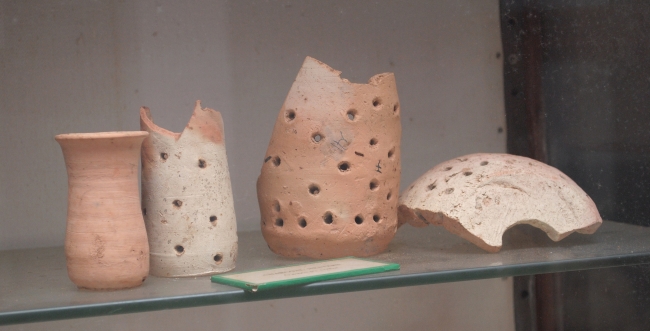
Perforated Vessels - courtesy Government
Museum, Chennai
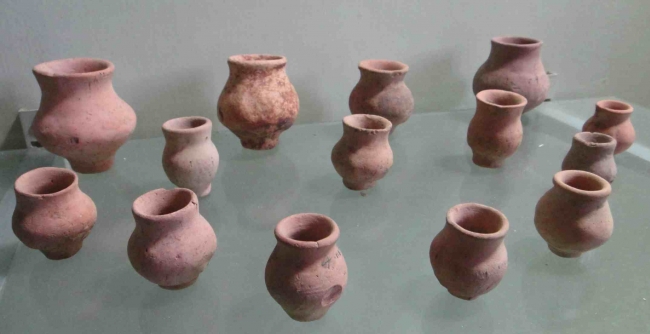
Miniature toy pots - courtesy Government
Museum, Chennai
| Page: 45 of 418 Go To Page: | |
◁◁ First | ◁ Previous | Next ▷ | Last ▷▷ |
Author: Dr. Stan Jones © Copyright 2010 -